Showing posts with label X-Men. Show all posts

Sunday, 9 March 2014

Deadpool: The Good, The Bad and The Ugly


Into its third volume the Deadpool MAX! series continues to be one of the best things Marvel are putting onto the shelves of comic shops. But it’s for a different reason than in the first two volumes (read about those here and here). While those books succeeded by emphasising Deadpool’s comedy, something which hasn’t been done right enough during the character’s twenty-plus year history, the third succeeds by exploring Deadpool’s more tragic elements.

It was something that could have failed. The title had been set up as something funny and so that’s what people had come to expect from it. But writers Gerry Duggan and Brian Posehn do such good exploring Deadpool’s history with Weapon X, and the stolen memories and deformed cancer patient sufferings that come with that, that you find yourself swept along.

In hindsight they were making readers care about Deadpool during their first two volumes too. But because they were doing it with humour, something you’d expect from the character and his titles anyway, it wasn’t noticeable. Also, you don’t tend to read something funny and think to yourself “yes, I am beginning to care about this character.” They’re a talented pair of writers.

There are still laughs though. Even when Deadpool finds himself fighting through North Korean concentration camps alongside deformed X-Men clone experiments he’s given wises to crack. But it’s the first two issues of the volume that are home to most of the laughs. The first is once again told as a flashback. It takes place in the seventies and sees Deaders teaming up with Iron First and Power Man to take on The White Man. Every joke you could expect with a villain who’s chosen that name is used, usually by or within earshot of Power Man. It’s gloriously silly, and a great start to the collection. It also helps to balance out the more grim surroundings of the rest of the volume.

Much was made before the arc started coming out as singles of Wolverine and Captain America’s involvement. While they’re used well and there’s a logical reason for their team-up with Deadpool they do at times feel a little surplus to requirements, like they’ve been added to the title to encourage crossover readership. Both are well written though. Cap in particular. He’s a character I don’t usually care for (which can’t just be because I’m not American) and it was nice to see him believably presented as a compassionate, caring man instead of the military genius poster boy he tends to be in various Avengers titles.

The new art of Declam Shalvey takes some getting used but it’s fine once you do. Even if you’re not keen on it it can be overlooked because the writing is so strong. Posehn and Duggan continue to be the best writers to ever work on a Deadpool title. And this title continues to be one of the greatest successes of Marvel’s NOW! initiative.

Sunday, 8 December 2013

X-Men: Days of Future Past


I'd open this with a joke about time travel never going out of fashion but I don't know how to structure it. Just imagine I've done it and chuckle to yourself about how clever an observation it was.

Days of Future Past is not only one of the greatest, if grammatically puzzling, titles for a comic story ever it's also a highlight of X-Men canon. Considering the number of stories that are regarded as classics within said canon that's not something I say lightly. It was written by Chris Claremont during his immense decade-plus run on the X-books. During that time he wrote more stories now considered classics than anyone else no named Stan Lee or Jack Kirby has for any other group or character. Days of Future Past is amongst his best.

The basic premise is that the adult consciousness of Kitty Pryde gets sent back in time, from 2013 eerily enough, to inhabit her teenage body in order to avert impending doom at the hands of an army of Sentinels. After the standard exchanges where she convinces the younger earlier incarnations that she is who she says she is, naturally enough featuring Wolverine’s heightened senses, the gang set about stopping an assassination attempt by Mystique's Brotherhood that proved a pivotal moment in history. It may sound basic now but that's because time travel has become so commonplace in TV, movies, fiction and pop culture in general. This story was ahead of its time and, more importantly is better than the average "timey-wimey" fluff that gets churned out today.

The time shifting shenanigans allow for more impactful moments than the average Marvel book, then or now. Claremont is free to kill off as many future incarnations of characters as he pleases, something he embraces. The death toll ratchets up, demonstrating that the future is indeed incredibly bleak and something the X-Men are right to try and avoid. Claremont also employs one of his favourite tricks, featuring reformed Magneto.

It’s a great piece of world building, a demonstration of Claremont’s skill as a writer of comic books. Using established continuity he creates a bleak world with a compelling history that’s both fleshed out and intriguing enough to make you want to explore it more. Unfortunately some people did just that: in the years since Days of Future Past first appeared Marvel have milked the DOFP continuity dry, coming as close as they can to robbing the original of its appeal. Fox are getting in on the act too, with a film adaption due out next year. Thankfully no matter how much inferior nonsense they pump out the original’s standing can’t be diminished.

Squeezed into just two issues Days of Future Past was and is a triumph, one that changed what an X-Men comic could do. It is one of the highest peaks of Claremont's lengthy X-Men career.

Sunday, 28 July 2013

Astonishing X-Men


Long before Joss Whedon gave us the phenomenally successful Avengers movie he wrote for Marvel's other high profile team, the X-Men. It was a risk, for both him and Marvel. Despite the fact that he'd spent much of the previous decade showrunning juggernaut TV hits Buffy and Angel, as well as the decidedly less commercially successful Firefly, Whedon was an unknown quantity in comics.

There was no guarantee that his skills would transfer away from their televisual home. He was also brought in to follow on from Grant Morrison's run as the de facto lead writer of the X-Men, Astonishing replacing Morrison’s popular New X-Men. Whedon was and is a bigger name in the general media than Morrison, but Morrison's name meant more to comic book buyers and there was no guarantee Whedon's fan base would carry over with him.

The decision turned out to be a good one. Whedon’s experience with writing Buffy and Angel, both of which are ensemble pieces despite their misleading titles, meant he knew how to write a team book like X-Men. Under Whedon each character has a distinct voice and understandable motives. Wolverine, for example, is mostly depicted as liking a beer and being very comfortable with his reputation as an intimidating killer. Cyclops, on the other hand, is a boy scout with an inferiority complex. Both could run the risk of being unoriginal but Whedon’s spin ensures that’s not the case thanks to well-timed moments of humour and pathos.

Despite having big name characters like Wolverine, Cyclops and Emma Frost to play with it’s Kitty Pryde at the centre of much of the story. Whedon displays an almost Warren Ellis-level of obsession with the character (read anything featuring her written by Ellis to see what I mean by this). It’s annoying with Ellis because it comes off as fetishisation whereas Whedon seems more interested in doing something new with an established character and her power of phasing.

Whedon also devotes a lot of time, particularly in early issues, to Ord of the Breakworld. He’s an alien villain introduced as one of the central antagonists of the series. Anyone who’s watched Buffy (yes, another reference to that show, sorry) will recognise Ord as a Whedon villain: a big threatening villain who has an understandable motivation for his beef with the X team, who gets shown to be mildly inept after his impressive initial appearance. Whedon’s never afraid to send up his bad guys but he does so with love: Ord is far from a one note villain or a glorified gag.

All of Whedon’s screen output is known for its snappy dialogue. The knack carries over to comics well. If he found it a struggle to limit the amount of dialogue he could give his characters, because he’s limited by the size of the page, it doesn’t show. Everything flows very naturally and his trademark moments of humour are alive and well. He loves the funnies, does Joss.

Of course, John Cassaday’s artwork doesn’t hurt. His clean, crisp line work and instantly recognisable characters make reading the book a joy. Having an artist who’s just as good at action sequences as he is at quiet exposition scenes is of real benefit to a writer like Whedon. Had he been paired up with Ed McGuinness things would have been very different.

On the subject of exposition scenes it’s worth mentioning the use of the danger room and the “thought space” of various psychic characters. Sometimes these are used for sight gags (Emma Frost enduring a particularly bumpy ride through space in a tea room, for example) while other times they’re used to add some colour to what would otherwise be bland infodumping scenes. They’re nice touches.

Sadly all of the witty dialogue, great artwork and solid characterisation is let down by a somewhat disappointing story. Things start off well with a six issue plot detailing the development of a cure for the X gene and continue being enjoyable when the danger room becomes sentient and reveals its plan to kill the X-Men.

The third arc is where things begin to go wrong. At first we’re led to believe the Hellfire Club have returned. That’s revealed to be wrong halfway through volume three, the villain instead being revealed as Cassandra Nova, one of the main antagonists of Morrison’s New X-Men. The fourth and final arc falls apart almost completely, as the background plot from the previous issues takes centre stage and the X-Men head off into outer space alongside SWORD supremo Agent Brand for an intergalactic showdown on the Breakworld.

Personal taste is part of the reason for my dislike of the fourth and final arc: the Marvel universe has a large enough number of concepts as it is without introducing aliens too. This is not Whedon’s fault, aliens have long been a part of the Marvel Universe. It’s just that their inclusion tends to make me lose interest. My feeling is that if people want to write about aliens in comics they should simply set up a creator-owned piece somewhere. There’s plenty of material in Marvel with the various superheroes, fictional countries and the worldwide problem of the X gene. Aliens serve to muddy the waters and on some level just feel a bit lazy.

The final arc lets itself down in other areas too. New characters are introduced at a rapid pace, making it hard to keep track of the plot. And scenes featuring Marvel’s large cast of regulars all crammed into an X book feels a little too self-indulgent for my taste. It’s as though Whedon’s decided that as this may be his only time working for Marvel (he was wrong there) he wants to use everyone he possibly can. All the positives of the early issues remain, but they’re not as prominent as they were.

Whedon and Cassaday’s Astonishing X-Men is a lovely looking piece of work that demonstrates everything you’d expect from both an X-Men book and something written by the man who brought you Buffy the Vampire Slayer. Reading this it’s clear he’s a fan of comics and Marvel in particular. If you can put up with a fudged ending it’s well worth a look. If you’re already a Whedon fan then you won’t even be bothered by the ending: you’ll enjoy the series regardless.

Sunday, 2 June 2013

Warren Ellis's Stormwatch


Stormwatch is the first entry in what can be considered a loose trilogy of Wildstorm titles for Warren Ellis. The second part would be The Authority and the concluding part would be Planetary. I didn’t realise this when I read them because I read them out of sequence. Not that you have to have read them in publication order of course, but certain references and recurring characters will make more sense if you do. My reading habits are a product of living in the age of collected editions.

Everyone who writes about Stormwatch mentions that its themes bled into The Authority and on into Planetary. It’s because the latter two titles are so incredibly highly regarded that it’s worth noting that the author figured out his voice for both here first. It’s interesting for its place in history and Ellis’s career as much as anything else.

It also helps to disguise the fact that, at times, Stormwatch can be a little rough around the edges. Part of the reason for that could be because this book was something Ellis inherited rather than created himself, the opposite of which would be the case with the later titles. This results in the author writing out numerous members of the existing cast and introducing his own new creations.

Authority stalwarts Jack Hawksmoor, Jenny Sparks, Swift, Apollo and Midnighter are all introduced here. So are the ideas of the Doctor and the Engineer. It’s clear at a glance that Ellis wants to be writing something wholly original rather than tinkering with the legacy of other people’s work.

The plots bear a striking similarity to The Authority. They’re on a smaller scale and tend to involve existing members of the team more, likely because Ellis didn’t have the sway at this point to use the approach he would later on, but they’re similar enough to the stuff turned out on The Authority to be an obvious precursor. It’s very much in the vein of shadowy cabals, secret societies and corrupt governments. Basically exactly the sort of thing Ellis has been doing for much of his career.

And yet it’s not solely just The Authority before The Authority. Ellis employs techniques that the “wide screen” approach wouldn’t lend itself to. Most obvious is issue forty-four. It’s a flashback story recounting the life of Jenny Sparks and employs artistic techniques that invoke various eras and titles, from pulp detective stories to Watchmen. It’s a less refined approach than what we would eventually see with Planetary but that it’s injected into just one issue, instead of across an entire series, makes it a little more focused.

This book is also of interest because it demonstrates the level of direction Ellis would garner within the Wildstorm Universe. As noted this was a book he inherited from other people. It was designed to sit alongside a wider range of titles and feature a level of crossover. By the time Planetary rolled around Ellis was essentially writing a creator-owned series in a shared universe. Stormwatch is the beginning of what would become Ellis’s impressive influence on an entire company’s output.

Content-wise the run is probably best known for a twist regarding one of the central characters. I shan’t spoil the nature of that here but I will say that it works well and adds a great deal to the plot. It’s also a rarity in comics in that it doesn’t happen for the sake of shocking or being a part of a company-wide crossover. It’s clearly something planned from the start. Yes, this is a vague paragraph. It’s tough to address a large part of the book whilst at the same time trying not to spoil it for anyone who’s not read the book (this is intended to be a recommendation after all).

If there’s one thing that I don’t especially care for about Ellis’s Stormwatch it’s the art of Tom Raney. It’s very of its time. You can tell from glancing at almost any page that it’s a nineties team book that was put out opposite the phenomenally popular X-Men. It would be overstating things to say it’s style over substance, but not by much. Something about Raney’s efforts just doesn’t quite gel. Whether its limbs being posed at peculiar angles, collapsing buildings looking like they’re doing things that defy physics (and not by design), or his sloppy approach to fight scenes (of which there are many) there’s always something just a bit off.

The below average artwork isn’t enough to stop Stormwatch being a very enjoyable read. Ellis produces some great work in its own right which becomes even more fascinating now that we have the benefit of hindsight to see where his career headed, both with specific follow-ups and with the general themes and tropes he’d adopt in general.

Sunday, 6 January 2013

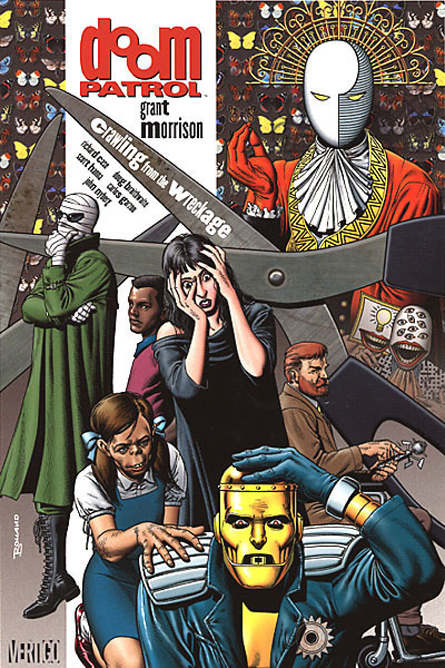
Doom Patrol


Grant Morrison’s run on Doom Patrol is probably the title’s most famous period, mostly because the author has gone on to become a massively influential force on the industry. His name on the cover is not the only reason the period is viewed fondly though. Morrison’s Doom Patrol is inventive and bizarre and has a wealth of odd characters populating its pages. Morrison successfully took existing team members and made them his own, something which has developed into a trend as his career has progressed. These are the definitive interpretations of the Doom Patrol regulars.

Unfortunately none of this means it’s a completely flawless read. Various aspects of the book fail to hold up two decades later. While Brian Bolland’s covers are wonderful displays capturing the anarchic plots of the issues they’re for the interior artwork from Richard Case is decidedly of its time. It feels scrappy and rough around the edges, failing to create a feeling that you’re reading something special. He does fare better when creating reasons to empathise with the characters, serving Robotman particularly well.

Another problem is the central villain, revealed in the sixth collected volume. The revelation that the professor has turned bad reads like a shock for the sake of a shock, another trope that has become associated with Grant (see in particular his various Infinite crossovers for DC). It does make sense by the end of the final issue if you’re willing to give the title the benefit of the doubt. The Candlemaker is a poor attempt at a major villain. He has an underwhelming, unmemorable look and motives that are impossible to decipher.

The title loses steam over time. It feels like Morrison becomes disinterested. It’s great until that happens though. Morrison tosses in some truly bizarre ideas. The Brotherhood of Dada is a highlight, a group of rogues who are more interested in causing trouble than world domination (or any other generally recognised trait of comic book villains). Members included a woman who had practically unstoppable powers but could only use them when she was asleep, the concept of distraction, a living whirlwind, and a woman who had every superpower you hadn’t thought of before facing her.

Another intriguing creation is Red Jack. A being that lives off pain and thinks he is both God and Jack the Ripper? The character could have overstayed his welcome but Morrison thankfully uses him judiciously and leaves us wanting more. It’s the kind of creation he is known for these days.

Issue 45 introduces us to the Beard Hunter, a man who hates facial hair so much that he is driven to kill anyone who sports it (a not-at-all-hidden play on the Punisher). Unsurprisingly he targets the only member of the Doom Patrol who has a beard. It’s a weird, silly idea that you couldn’t get away with in most comics. There’s a living street called Danny, an infinite city, scissor men who cut people out of reality, and a bit part golden age homage named Flex Mentallo who proved so popular he got his own miniseries. Morrison tosses out ideas like they’re going out of style.

As mentioned above Morrison serves the regulars well. Cliff remains the relatable everyman similar to the Fantastic Four’s Thing while Negative Woman is revamped into a deliberately unrelatble omnipotent hermaphrodite. The Chief (again, as mentioned) is revealed to have gone a bit wrong, which gives him some substance and a reason for existing beyond being a wafer thin Professor X analogy. It’s a twist for the sake of a twist but it at least makes use of the tools Morrison has at his disposal.

Crazy Jane and Danny the Street are the creative team’s own contributions to the group’s roster, and they also fleshed out a background character that first appeared before they took over into Dorothy Spinner. Danny is the aforementioned sentient street that acts as base of operations for the team. Jane is a young woman with multiple personality disorder, each persona possessing its own power. Dorothy is a young girl with a monkey face who is responsible for the Candlemaker’s existence. The Doom Patrol should’ve offed her when they first met her to save themselves (and us) some bother.

Despite its faults Morrison and Case’s Doom Patrol is a fun and inventive title that never fails to surprise. While its ideas and artwork aren’t the most consistent it’s worth reading for when things go right. Anyone interested in the career progression of Grant Morrison, and his regular themes of sexuality, political commentary, and society’s present and future, will not be disappointed.

Sunday, 28 October 2012

New X-Men


The X-Men are generally thought of as a large team. The modern comic book landscape has encouraged this view, with Marvel cashing in on their popular franchise by running half a dozen or more books bearing the X name at any one time (almost all of which feature Wolverine, in a surprisingly varied number of outfits). Some titles are naturally better than others, thanks to the diverse range of authors and artists working on the books and the characters they are permitted to use.

In 2001 Marvel brought lauded writer Grant Morrison on board to revamp their X books. While other titles were still produced during Morrison’s run it was clear that his New X-Men was the “main” one. The one where all the stuff that truly mattered would happen.

Morrison made sweeping changes to the group and the title. He pared the membership of the team right back, presenting us with a six person outfit consisting of Cyclops, Beast, Emma Frost, Jean Grey, Professor Xavier, and, of course, Wolverine. They were joined by debuting peripheral characters Beak, Angel Salvadore, and the Stepford Cuckoos. The first several stories Morrison told concentrated on the existing stars. The newcomers became more prominent over time, allowing readers to get to know them at a natural, unforced pace.

The X-Men were kitted out in new black and yellow outfits, which helped to make them look more like a team and less like a disparate bunch of camp cosplayers, and the book gained itself a snazzy new name and logo. The word New hadn’t been appropriate for an X-Men title for quite a while, and it arguably wasn’t relevant here. Marvel used the name anyway.

Morrison controversially altered the look of Beast, taking him from ape-like to cat-like. Many disliked the change but as Morrison pointed out Hank McCoy had started out as a regular(ish) looking guy with oversized hands and feet. The move to a cat was presented as a progression of the character’s X-gene and formed the basis for Morrison’s final story.

Emma Frost gained a secondary power. In addition to telepathy it was revealed she could turn her body into a diamond-like substance. Useful for a superhero, no?

The book also gave us the first appearances of Fantomex and the ultimately controversial Xorn character. Fantomex has always struck me as a far too powerful character and one created designed to be cool rather than layered or interesting. Most people disagree and cite him as one of Morrison’s greatest achievements while writing New X-Men.

Xorn is another kettle of fish entirely. With him Morrison did manage to create a layered and interesting character, one that fans and critics alike loved. He was vulnerable and different to the rest of the cast. The identity of Xorn is a major event during the run so I shan’t spoil it here, but suffice it to say that when you find out who has been under the mask all along you’ll find yourself checking previous issues. The plan, plot and character reasoning make no sense.

Morrison returned a sense of unpredictability to the X-Men that had been missing for a while. The team had spent much of the 90s being broody in dull, unimaginative stories or retreads of past glories. From early on it’s clear Morrison wants to do things with the team that haven’t been done before, putting them into new situations and surroundings while staying true to their history and maintaining the traits that made them originally appealing.

Chris Claremont was famed for including analogies of racism, gender inequality and various other types of persecution in his X-Men titles. Morrison very much tries to follow suit. For the most part he succeeds.

But in amongst all these changes, new characters, and expanded worlds are there good stories? At the beginning of the run, yes.  Morrison produces some fairly imaginative storylines. An early story sees Professor X seemingly turning evil, for example. That’s a simple idea but one that had never been done before (certainly not in this fashion at any rate).

There’s a problem with the title though. The artists are nowhere near consistent enough. When Frank Quitely is on pencil duty the book is a joy and a triumph. He understands how to put Morrison’s thoughts onto the page better than anybody else. Unfortunately he’s around less and less as Morrison’s creative run goes on, and almost all of the fill-in artists are dreadful. Busy panels, sloppy inking and inconsistent character designs make the book painful on the eye as early as halfway through the first volume (of three).

The series ends on a high with Morrison’s own attempt at a Days of Future Past type plot. It brings together elements, some major, some minor, spanning Morrison’s run. The basic gist is that Beast has gone bad and waged war on the rest of the X-Men, determined to retrieve and revive the Phoenix to rule the world (or something equally nefarious). At points it comes across as an over-the-top apocalypse movie form the 80s but it works well and allows the Morrison era of the book to end on a high. Perhaps Morrison should try an 80s apocalypse movie-style film script at some point?

If you can look past haphazard artwork there’s a lot to enjoy about New X-Men. Sadly that’s far easier said than done.
 
Critical information:
Writer: Grant Morrison
Artist: Various