Showing posts with label Brian Bolland. Show all posts

Sunday, 23 February 2014

Dial H (The Complete Series)


When I first started this blog I wrote about the first four issues of Dial H. You can read the full thing here but I summed up by saying that Dial H had been one of the surprise hits of the New 52 relaunch and was one of the most inventive and enjoyable comic books available.

A brief refresher for those who've forgotten or were unaware to begin with. Dial H begins as a story about Nelson Jent, an overweight fella who discovers a magic phonebox near his flat (apartment, whatves) that can turn people into superheroes for a limited time. It began as a reboot of old title Dial H For Hero, designed only to play a minor and peripheral part in DC's New 52 event-slash-crossover-slash-reboot.

The old title featured protagonist Robby Reed getting into scrapes that could only be solved via use of the phonebox (it was a simpler, less demanding time for comic writers). China Mieville, author of the New 52 edition, took a different approach. Instead of a weekly adventure approach he wrote a long-running plot that involved alternate universes, reality-eating monstrosities, and, fittingly but surprisingly, the history of telephones. It was often difficult to read but in hindsight that was only because Mieville was writing each issue as a chunk of a whole. When the first six issues were done they told their own satisfying story that made sense, though there were obviously some threads left dangling. With Mieville being a novelist this was to be expected.

And that was just the first six issues. After that Mieville began focusing on what really interested him: the origins of the phonebox. He took the relatively simple idea of a phonebox that gives superpowers to ordinary people (something I suspect original creators Jim Mooney and Dave Wood lifted from Superman) and created an entire mythology around them. It's staggering how much detail Mieville manages to pack in about the history of the dials. He works in an otherworldly war, phone lines as another plane of existence, and multiple new dials, as well as addressing the question of where the dialled superheroes actually come from. It's an incredible achievement not only to have thought of everything he has bit to have written it in a way that seems fluid and natural. It could easily have been a case of continuous and boring infodumping. Mieville writes a story that’s fascinating and enjoyable, something that can be appreciated for its invention, its humour and story.

The artists who worked on the series warrant a mention too. Mateus Santolouco drew the first six issues (numbered zero to five) and did just as much as Mieville to establish the tone of the book with his grubby, dingy backstreets and bright, colourful and charismatic superheroes. Fill in artist David Lapham did a fine job and was replaced permanently by Alberto Ponticelli. He was more in line with the regular DC artist, someone who draws action sequences and dynamic poses, but he also understood the quirky nature of Dial H. In particular he triumphed with Open Window Man and The Centipede, strange characters who could easily have lost a lot of their impact with the wrong artist. Brian Boland provided a cover for each of the series’ issues. They were predictably excellent.

Sadly DC is apparently not a company willing to fund satisfying creativity. Dial H didn't get good enough sales and so was cancelled after seventeen issues. As DC is a company that makes more than enough money from its big titles, merchandise and films I think they could have allowed for a title that lost them money but was a creative success. In the long run it probably would have paid off for them as trade paperback and digital sales could have recouped cash in the long term.

Apparently it wasn’t worth keeping around even for that. They did at least have the good grace to grant Mieville time to wrap things up and allocated him an extra-long final issue. The reduced time resulted in a truncated conclusion (I suspect far longer would have been spent exploring the concept of various other dials had the book continued) but it did at least get to end. So many inventive series don't even get that.

Although it didn't go on for as long as Mieville would probably have liked Dial H is still something worth treasuring. It's a clever, imaginative read that's uncompromising in its pacing but knows where it’s going. It is one of Mieville’s greatest accomplishments.

Sunday, 17 November 2013

Batman: The Killing Joke


As its title indicates Batman: The Killing Joke is as much a Joker book as a Batman book. This may not seem particularly noteworthy now, when an entire month’s worth of DC comics can be dedicated to pushing villains to the fore and there are almost as many anti-heroes as there are straight villains. But in the late eighties the approach was still new enough to be a novelty. Even with a big name baddie like Joker. Which was almost certainly a factor when Alan Moore decided he wanted to write it.

The plot is fairly basic. Joker targets Commissioner Gordon with a series of vicious pranks and attacks, his goal bring to prove that anyone can be taken down to their lowest, insane ebb with one bad day. Batman saves the day (natch) by tussling with Joker and saving Gordon from his seemingly overwhelming despair. Along the way we get a look at The Joker before he became The Joker and Barbara ‘Batgirl’ Gordon gets shot.

I'm paraphrasing but that's the basic gist.

The shooting was a rare example of a comic book occurrence that had a long term impact. Barbara remained paralysed until DC’s line-wide reboot in 2011. It wasn’t something cynically dreamt up to create a readership spike, it was something Moore devised to have dramatic impact. It did and does.

As a Batman comic it works. It does something new with established characters without betraying their roots or emotions and captures the gritty feel of Gotham City. As an Alan Moore comic it also works. A bad guy dragging a morally courageous man down to his level just because he can is exactly the sort of thing Alan Moore is known for writing.  

The book is well-written and nicely paced over its dozens of pages. It's entertaining and benefits from some lovely art provided by Brian Bolland (with the deluxe edition currently on bookshelves getting a great recolour job also provided by Bolland). Perhaps most importantly it followed on from the themes that began with Frank Miller’s The Dark Knight Returns and played into the darkening of the Batman character. That's something we take for granted now as it's been the standard approach for twenty-five years, but it wasn't the guaranteed recipe for success when written that it is now. The approach has been a factor in the character's longevity, and we have Alan Moore (as well as Miller) to thank for that.

Sunday, 6 January 2013

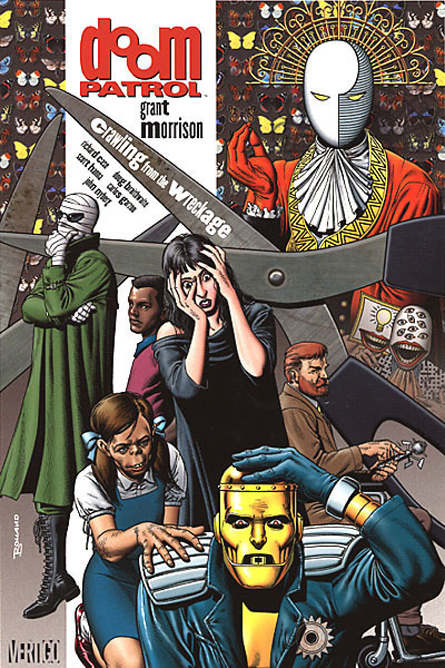
Doom Patrol


Grant Morrison’s run on Doom Patrol is probably the title’s most famous period, mostly because the author has gone on to become a massively influential force on the industry. His name on the cover is not the only reason the period is viewed fondly though. Morrison’s Doom Patrol is inventive and bizarre and has a wealth of odd characters populating its pages. Morrison successfully took existing team members and made them his own, something which has developed into a trend as his career has progressed. These are the definitive interpretations of the Doom Patrol regulars.

Unfortunately none of this means it’s a completely flawless read. Various aspects of the book fail to hold up two decades later. While Brian Bolland’s covers are wonderful displays capturing the anarchic plots of the issues they’re for the interior artwork from Richard Case is decidedly of its time. It feels scrappy and rough around the edges, failing to create a feeling that you’re reading something special. He does fare better when creating reasons to empathise with the characters, serving Robotman particularly well.

Another problem is the central villain, revealed in the sixth collected volume. The revelation that the professor has turned bad reads like a shock for the sake of a shock, another trope that has become associated with Grant (see in particular his various Infinite crossovers for DC). It does make sense by the end of the final issue if you’re willing to give the title the benefit of the doubt. The Candlemaker is a poor attempt at a major villain. He has an underwhelming, unmemorable look and motives that are impossible to decipher.

The title loses steam over time. It feels like Morrison becomes disinterested. It’s great until that happens though. Morrison tosses in some truly bizarre ideas. The Brotherhood of Dada is a highlight, a group of rogues who are more interested in causing trouble than world domination (or any other generally recognised trait of comic book villains). Members included a woman who had practically unstoppable powers but could only use them when she was asleep, the concept of distraction, a living whirlwind, and a woman who had every superpower you hadn’t thought of before facing her.

Another intriguing creation is Red Jack. A being that lives off pain and thinks he is both God and Jack the Ripper? The character could have overstayed his welcome but Morrison thankfully uses him judiciously and leaves us wanting more. It’s the kind of creation he is known for these days.

Issue 45 introduces us to the Beard Hunter, a man who hates facial hair so much that he is driven to kill anyone who sports it (a not-at-all-hidden play on the Punisher). Unsurprisingly he targets the only member of the Doom Patrol who has a beard. It’s a weird, silly idea that you couldn’t get away with in most comics. There’s a living street called Danny, an infinite city, scissor men who cut people out of reality, and a bit part golden age homage named Flex Mentallo who proved so popular he got his own miniseries. Morrison tosses out ideas like they’re going out of style.

As mentioned above Morrison serves the regulars well. Cliff remains the relatable everyman similar to the Fantastic Four’s Thing while Negative Woman is revamped into a deliberately unrelatble omnipotent hermaphrodite. The Chief (again, as mentioned) is revealed to have gone a bit wrong, which gives him some substance and a reason for existing beyond being a wafer thin Professor X analogy. It’s a twist for the sake of a twist but it at least makes use of the tools Morrison has at his disposal.

Crazy Jane and Danny the Street are the creative team’s own contributions to the group’s roster, and they also fleshed out a background character that first appeared before they took over into Dorothy Spinner. Danny is the aforementioned sentient street that acts as base of operations for the team. Jane is a young woman with multiple personality disorder, each persona possessing its own power. Dorothy is a young girl with a monkey face who is responsible for the Candlemaker’s existence. The Doom Patrol should’ve offed her when they first met her to save themselves (and us) some bother.

Despite its faults Morrison and Case’s Doom Patrol is a fun and inventive title that never fails to surprise. While its ideas and artwork aren’t the most consistent it’s worth reading for when things go right. Anyone interested in the career progression of Grant Morrison, and his regular themes of sexuality, political commentary, and society’s present and future, will not be disappointed.