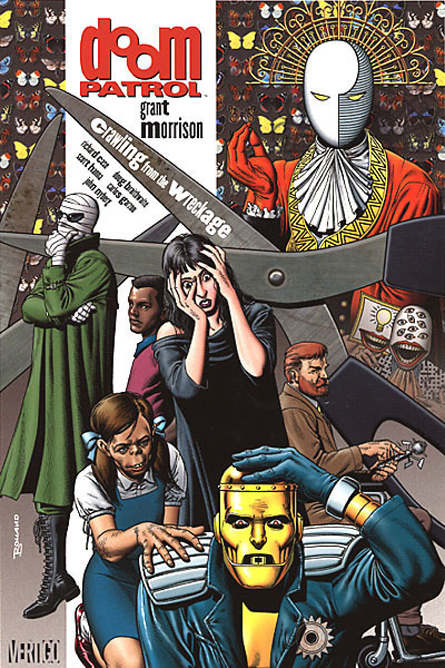
Grant Morrison’s run on Doom Patrol is probably the title’s most famous period, mostly because the author has gone on to become a massively influential force on the industry. His name on the cover is not the only reason the period is viewed fondly though. Morrison’s Doom Patrol is inventive and bizarre and has a wealth of odd characters populating its pages. Morrison successfully took existing team members and made them his own, something which has developed into a trend as his career has progressed. These are the definitive interpretations of the Doom Patrol regulars.
Unfortunately none of this means it’s a completely
flawless read. Various aspects of the book fail to hold up two decades later.
While Brian Bolland’s covers are wonderful displays capturing the anarchic
plots of the issues they’re for the interior artwork from Richard Case is
decidedly of its time. It feels scrappy and rough around the edges, failing to
create a feeling that you’re reading something special. He does fare better
when creating reasons to empathise with the characters, serving Robotman particularly
well.
Another problem is the central villain, revealed in the
sixth collected volume. The revelation that the professor has turned bad reads
like a shock for the sake of a shock, another trope that has become associated
with Grant (see in particular his various Infinite
crossovers for DC). It does make sense by the end of the final issue if you’re
willing to give the title the benefit of the doubt. The Candlemaker is a poor
attempt at a major villain. He has an underwhelming, unmemorable look and
motives that are impossible to decipher.
The title loses steam over time. It feels like Morrison becomes
disinterested. It’s great until that happens though. Morrison tosses in some
truly bizarre ideas. The Brotherhood of Dada is a highlight, a group of rogues
who are more interested in causing trouble than world domination (or any other
generally recognised trait of comic book villains). Members included a woman
who had practically unstoppable powers but could only use them when she was
asleep, the concept of distraction, a living whirlwind, and a woman who had
every superpower you hadn’t thought
of before facing her.
Another intriguing creation is Red Jack. A being that
lives off pain and thinks he is both God and Jack the Ripper? The character
could have overstayed his welcome but Morrison thankfully uses him judiciously
and leaves us wanting more. It’s the kind of creation he is known for these
days.
Issue 45 introduces us to the Beard Hunter, a man who hates facial hair so much that he is driven to kill anyone who sports it (a not-at-all-hidden play on the Punisher). Unsurprisingly
he targets the only member of the Doom Patrol who has a beard. It’s a weird,
silly idea that you couldn’t get away with in most comics. There’s a living
street called Danny, an infinite city, scissor men who cut people out of
reality, and a bit part golden age homage named Flex Mentallo who proved so
popular he got his own miniseries. Morrison tosses out ideas like they’re going
out of style.
As mentioned above Morrison serves the regulars well.
Cliff remains the relatable everyman similar to the Fantastic Four’s Thing
while Negative Woman is revamped into a deliberately unrelatble omnipotent hermaphrodite. The Chief (again, as
mentioned) is revealed to have gone a bit wrong, which gives him some substance
and a reason for existing beyond being a wafer thin Professor X analogy. It’s a
twist for the sake of a twist but it at least makes use of the tools Morrison
has at his disposal.
Crazy Jane and Danny the Street are the creative team’s
own contributions to the group’s roster, and they also fleshed out a background
character that first appeared before they took over into Dorothy Spinner. Danny
is the aforementioned sentient street that acts as base of operations for the
team. Jane is a young woman with multiple personality disorder, each persona
possessing its own power. Dorothy is a young girl with a monkey face who is
responsible for the Candlemaker’s existence. The Doom Patrol should’ve offed
her when they first met her to save themselves (and us) some bother.
Despite its faults Morrison and Case’s Doom Patrol is a fun and inventive title
that never fails to surprise. While its ideas and artwork aren’t the most
consistent it’s worth reading for when things go right. Anyone interested in
the career progression of Grant Morrison, and his regular themes of sexuality,
political commentary, and society’s present and future, will not be
disappointed.

