Showing posts with label Grant Morrison. Show all posts

Sunday, 27 October 2013

Flex Mentallo


Flex Mentallo first appeared during Grant Morrison’s time writing Doom Patrol. He was a throwaway addition designed to act as a parody of a Charles Atlas advertising character as well as golden age comic tropes in general. His power of flexing muscles, which sorted out seemingly any problem, seemed designed to draw attention to how simple, which is to say wholesome and free of worry as opposed to foolish or stupid, comic books of the past were.

The character was well-suited to a minor appearance in a book like Doom Patrol. It was a title that thrived on being quirky and strange and Mentallo’s oddball power and eccentric look (he wears a pair of leopard print strongman trunks and a gabardine mac) were a natural fit. That was never going to be enough for Grant Morrison. He had to pluck this one dimensional character from relative obscurity and award him his own four issue series.

In principle that’s a decision that could have worked. Had Morrison used the title as a tool to frame his feelings and thoughts on the golden age of comics it could have been an interesting read. Mentallo would have been the perfect creation for such a comic, being a modern creation designed to ape the standards of a previous era he would have had a different relationship to the source material than other characters. What’s more this is a comic I can imagine Morrison having an interest in writing. He’s penned an entire book on the history of superheroes and comic books in general. Imaging that he’d like to write something in the golden age style is an easy leap to make.

But that’s not we’ve got. Part of the book’s trouble is that it’s very difficult to say what we have instead.

It starts out well enough. We’re introduced to Mentallo at an airport, where he stumbles across a case that needs to be solved and, well, sets about solving it. His investigations quickly reveal that the man he’s looking for is an old accomplice of his, The Fact, who Mentallo believes to be a fictional creation. It’s at this point that we learn Mentallo is aware that he used to be fictional too, but was drawn out of pages he was scribbled on by his creator, Wally Sage.

It’s an intriguing premise that Morrison mostly ignores, instead deciding that what his four issue miniseries needs is more ideas. He revisits the idea of comic book characters being real at the end of the book and we again get a glimpse of how good a concept it is. It’s revealed that the world the book’s set in used to have thousands of superheroes in it, loving and protecting the peoples of the world, but they ran into some bother and only managed to save themselves by turning themselves into pure ideas that survived in reality as comic book characters.

These revelations come out over just a few pages in the fourth issue, rendering an idea stuffed with potential for greatness wasted. It’s the standard problem with Morrison’s work: he tends to have pretty good ideas but crams too many into a title, leaving them all frustratingly underdeveloped.

Even by his kaleidoscope standards Morrison seems unfocused with Flex Mentallo. He makes a big deal about how much raw creativity goes into the comics kids draw for themselves but never really pays the thread off or fully explains what his point is. He mentions parallel universes and timelines continuously but they never feature in any meaningful sense. He creates an incredible number of superheroes and –villains, with many of them ironically seemingly inspired by the silver age of comics, that feel wasted.

Reading the series it feels as though Morrison is desperate for it to be about something. But he’s so desperate to achieve this that he tosses in too much and the half-formed and unfocused results end up nothing but a disappointment. It’s possible that someone could drag some sense out of Flex Mentallo with some rereading but that person’s not me.

It’s ironic that a book with a central character based on the most simplistic age of comic books is such a tangled, convoluted mess. It’s also a shame. Frank Quitely does his usual job of transforming Morrison’s script into something that is visually engaging, inventive and fun and the book always feels as though it’s on the cusp of becoming really good. But it never does. As nice as it looks, and perhaps sounds, this is not something I can recommend.

Sunday, 15 September 2013

JLA Earth 2


The idea of showing evil versions of established superheroes is not a new one to comic books. Both Marvel and DC have been stories about bad reflections of their good guys, and each other’s, going back decades. It’s a well-worn trope of the medium.

It is, of course, something DC have recently returned to with their Forever Evil crossover. In many ways it’s comparable to JLA Earth 2, a Grant Morrison and Frank Quitely collaboration from 2000. For his part Quitely produced predictably excellent work. Everything about his art style was perfectly judged. The deliberately inflated physiques of the superpowered characters doesn’t feel silly, they feel a natural fit for the story being told. The alternate outfits are a blend of older costumes and stereotypically villainous designs.

Quitely’s work is far better than Morrison’s. Whether he’s drawing a decidedly square-jawed and masculine Superwoman (the evil version of Wonder Woman) or giving us a splash page where Green Lantern grabs hold of the moon with titanic hands he’s always creative and clear.

Morrison starts off with a nice idea. A bad version of the JLA ruling over a universe where they always win and the only man who stands up to them, Lex Luthor, is doomed to repetitive failings is a good concept. The teases of backstory we get for the Crime Syndicate are intriguing. Pleasingly they’re not elaborated on, leaving an air of mystery.

Where Morrison falls down is with his convoluted plot. Not happy to jut have bad versions of the JLA clash with good versions of the Crime Syndicate Morrison has to have the entire plot hinge on a minor character introduced early on. It’s a disappointment that he falls back on tying things into continuity references and gibberish about matter and anti-matter coexisting. It’s not what people read comics for. It would have been enough to just have the two teams face off in a climactic fight scene, especially when the book’s so slight.

That said Morrison does include nice throwaway details for the universe. Thomas Wayne being the chief of Gotham City’s police force, standing up to Boss Gordon and the tyrannical Owlman unfolds at a nice pace throughout the slender volume. It’s an idea that could have supported a story in its own right. Perhaps it should have.

The first page shot of the Crime Syndicate’s moonbase is beautifully drawn and a nice introduction. The first time we see the heroic, anti-matter Luthor after he’s crash-landed in a scene that deliberately reflects the Superman origin is nice, as is one of his earliest line “You are human. I am Luthor.” Morrison even captures the spirit of mainstream JLA tales by having the gang work on small scale problems such as saving a plane or rebuilding a city together, despite being an international supergroup.

It’s a mixture of a book. Ultimately it’s worth a look because of Quitely’s art and the general concept of the thing. It falls apart as soon as Morrison has to start paying things off, but that’s nothing new with him. His good ideas in this outweigh his bad, and his poor judgement of the resolution.

Sunday, 14 July 2013

Grant Morrison's Animal Man


I’d like to start by saying that Animal Man is very good. It’s quite possibly the best thing I’ve read written by Grant Morrison. I’ve noted before that he has a habit of going overboard when writing and that spoils his otherwise very interesting concepts and ideas. It happens here. He goes overboard just as much as he does in Doom Patrol or The Invisibles but nothing is spoilt.

Animal Man, as written by Morrison, was originally meant to be a four issue mini-series revolving around a character who hadn’t been used by DC for years. Those first four issues aren’t actually terribly enjoyable. Nor are they noticeably bad. They exist simply as perfectly average issues that, had they not been written by Morrison would be completely unmemorable. They tell a fairly convoluted story featuring an African superhero with the power to meld animals together saving a monkey from a science lab.

For whatever reason those in charge of DC’s Vertigo imprint were suitably impressed by that tale and decided to offer Morrison money in exchange for sticking with the character. It was after that initial tale wrapped up that Morrison became more experimental with the Animal Man and the comic in general, finally hitting his stride with the title.

There are two big themes running throughout Morrison’s Animal Man. The first is animal rights. It’s a subject Morrison felt very strongly about (and presumably still does). Writing a character called Animal Man was always going to make animal cruelty and related issues an obvious subject to tackle. Morrison does addresses the issues better than most would do in a comic.

We see the horror of scientific experimentation, the thuggish brutality of some of the more militaristic animal rights movements, and the full, titanic scale of the problems clumped under the “animal abuse” umbrella. The point is made more than once that it’s not just animal abuse that’s the problem, it’s humanity’s treatment of the planet in general. It’s a subject very well handled considering the space limitations of the medium, not to mention the fact that not all his time and energy are dedicated to the topics.

The other theme is what Animal Man is probably most well-known for under Morrison. That is the metafictional nature of his writing on the book.

Famously the final issue depicts a meeting between Animal Man and his then-current writer. During this Morrison admits that he feels their conversation is anti-climactic. He has so much to say and not enough space to say it. Towards the end the writer conjures up some humorous bad guys for Animal Man to fight so he can spend a page thanking artists, colourers, letters, and editors. He then takes the memory of the meeting away and sends Buddy Baker back to his fictional world to reunite with his resurrected family.

That final issue is the famous and obvious example of Animal Man being metafictional under Morrison but there’s so much more to it than that. Hints at what Morrison’s building to are dropped into his run very early. It doesn’t just come out of nowhere. You can go through and trace Morrison’s plan from the first collected volume of the book. This is not something you can praise his work with these days. Back in the eighties he was still conscientious enough to construct plots that could be followed by someone who doesn’t have a PhD in comics’ lore.

Morrison seems keen to look at the nature of readers’ relationship with fiction, and comics specifically. He looks extensively at the concept and rules of continuity, with the then-recent Crisis on Infinite Earths being referenced multiple times. Characters see the reader numerous times throughout the book and Morrison introduces a number of characters, both major and minor, who are aware of their fictional status. Sometimes these things are played as serious and sometimes they’re gags. It’s a fascinating idea and one that Morrison has returned to throughout his career. He has arguably never been as good at saying what he has to on it as he is on Animal Man.

As is always the case with Morrison his work is far from perfect. The plot falls apart briefly in the middle. Most of the second volume is a bit of a muddle at the start thanks to a multi-issue arc focusing on a trip to Africa. Part of the reason this doesn’t work is that Morrison spends most of the rest of his time on the book writing standalone entries with character led side plots providing most of the linking material between issues. It’s jarring when a story isn’t wrapped up in twenty-four pages.

This is the first major work of Morrison’s career. Considering his status it would probably be worth looking at even if it was a complete mess. But it’s not a mess. It’s an incredibly well-planned, thoughtful, and creative book that shows how good Morrison is when he’s on form. It’s a book that anyone with an interest in comics as a medium should definitely make time to read.

Sunday, 9 June 2013

Batman and Robin


Even though I grew up in the 80s I still watched the Adam West Batman TV show when I was young. It was repeated regularly, on Channel 4 I think. I enjoyed it, but it wasn’t something I was desperate to watch. It was mainly on so that my mum could have some peace I think. Not that this matters, of course. I was only young but even then I knew it was a faintly ridiculous show. I didn’t know words like camp or kitsch (or faintly ridiculous) but there was an air to it that you didn’t get with other shows.

As an adult it’s easy to identify what’s peculiar about the show (beyond it being camp, kitsch and faintly ridiculous). It presents Batman differently to every other major (and minor for that matter) depiction the character’s ever had. He’s not the grizzled renegade stalking the streets of Gotham City by night, he’s a deliberately overly dramatic fop who only comes out during the day to battle the most ineffective bunch of hoodlums you’re ever likely to stumble across. You can’t imagine Adam West’s Batman stalking anywhere.

Despite being about as far removed from the modern and popular presentations of The Batman as you can get the show worked and still holds up pretty well today. It takes its inspiration from the comics but it’s not of that world. It plays by its own set of rules and has no interest in trying to make Batman look serious, something the comics have increasingly become obsessed with over the decades.

It’s this incarnation of Batman that Grant Morrison says he drew inspiration from for his 2009 ongoing title Batman and Robin. By the time the first issue came around Morrison had essentially been the head writer of the Bat-franchise for three years and had taken the character and his supporting cast in a variety of surprising directions. He’d reintroduced elements of canon most had assumed had been quietly dropped and revived the forgotten spirits of Batman through the ages, such as his brushes with science fiction and his detective roots.

Prior to the launch of Batman and Robin Morrison had produced an arc that saw original Batman Bruce Wayne die. Damien Wayne, Bruce’s estranged son whose mother was Talia al Ghul and grandfather was Ra’s, had been brought back to the various Bat titles after a fleeting appearance in the eighties, and Dick Grayson had been established as the obvious successor to Bruce should anything unfortunate happen.

The book focused on the new pairing of Dick and Damien as Batman and Robin. Despite having come about as the result of a death the emphasis for the new book was on fun. Which is where the citing of the Adam West TV show as a source of inspiration presumably stems from. Because no interpretation of Batman has ever been more fun than West’s.

Part of the appeal was in the role reversal that initially took place between the new Dynamic Duo. Dick proved a calmer, more thoughtful Batman than Bruce had, embodying his finer attributes with a warmer approach to dealing with people. Damien was written as a hothead keen to mete out justice to wrongdoers and was very vocal on the subject of wanting to be Batman, his feeling being that as Bruce’s son he was the natural heir. It’s an interesting subversion and one that Morrison writes well without careening into overkill.

Sadly the book never really amounts to much, despite having a lot going for it. The opening three issue arc sees Batman and Robin tangling with Professor Pyg, a man who enjoys nothing more than kidnapping people and mutilating their faces. It’s arguably the highlight of the title’s run. Later arcs would feature tie-ins to other Bat titles and the DC-wide Blackest Night crossover event, which put a serious dent in the direction the book could take.

It doesn’t hurt that those opening issues are pencilled by Morrison’s pal and frequent collaborator Frank Quitely. He’s given the chance to draw circus freaks and a villain called Mr Toad, who seems to be based strongly on the version of the character seen in Wind in the Willows animated series from Cosgrove Hall. It’s right up his alley and he produces striking visuals that help to set the book apart from most of the other comics DC (or anyone else) were putting out at the time.

Quitely was replaced by Philip Tan and a number of other artists. While nobody who worked on the series alongside Morrison could be considered bad nobody produced anything as captivating as Quitely did. It didn’t help that stories became more generic. In addition to tying into crossovers they seemed to be turning towards the standard dark stories that we’d been explicitly told would be avoided.

The book essentially became a standard, and skippable, Batman book when Morrison left. He was replaced for three issues by Paul Cornell before Peter Tomasi as the regular scripter. Tomasi has his strengths as a writer but taking Batman in bold new directions while invoking a TV show that goes against the way the modern character is presented, and telling fun, frothy stories to boot, is not among them.

I’d highly recommend buying the first collected edition of Batman and Robin. Disappointingly anything after issue seven (the comic ran for over twenty issues before getting renumbered during DC’s New 52 event which is remarkably still trundling on) is instantly forgettable but that opening stretch is definitely worth a look thanks to the great art and Morrison bothering to deliver hat he originally promised.

Sunday, 10 February 2013

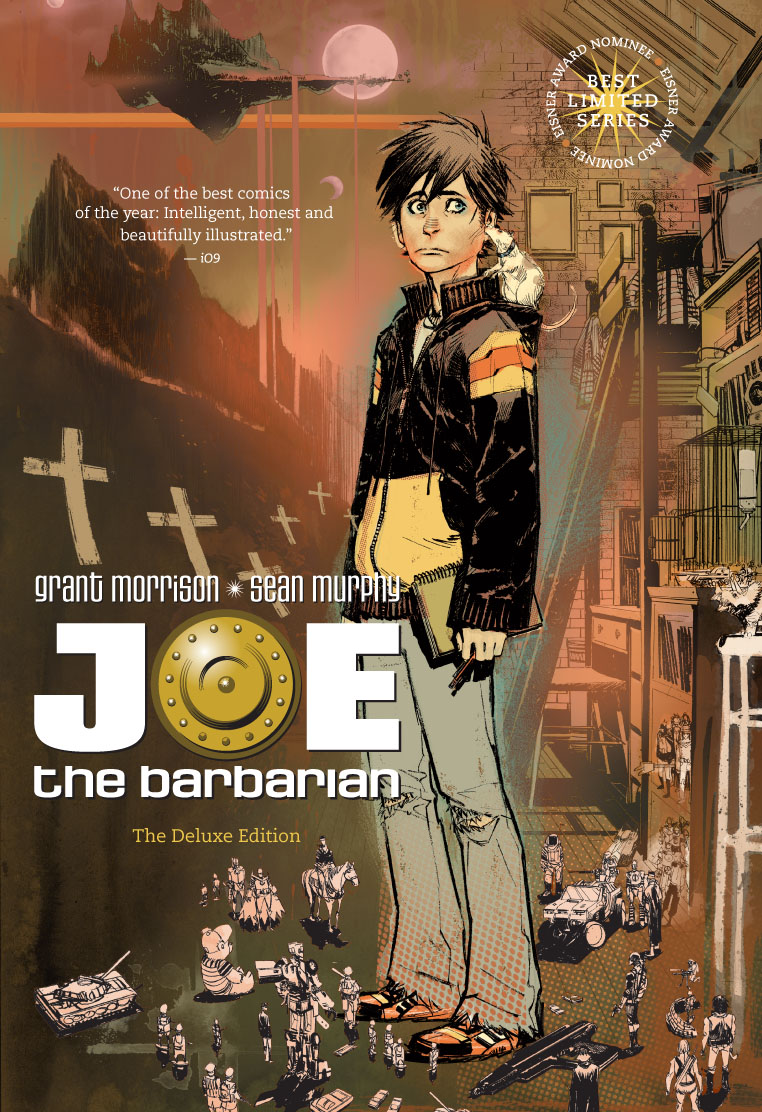
Joe the Barbarian


Before I give my thoughts on Grant Morrison and Sean Murphy’s Joe the Barbarian two things should be pointed out in the interest of fairness. Firstly the series won an Eisner Award. That marks it out as something significantly special. Not just anything gets an Eisner. Secondly I am not Grant Morrison’s biggest fan. This book is a near perfect example of why that’s so.

The problem I have with Morrison is that he so often seems to go for style over substance. There always seems to be an underlying drive to show how cool he is and how much he knows about mysticism, drug experimentation, society’s fringes and other things that don’t necessarily translate well to the world of comic books. Were this his only characteristic I doubt I’d ever have any interest in any of his comics. I also doubt he would have become such a prominent author. One trick ponies rarely find success to the level Morrison has.

These bad points are tempered by an incredible creativity. This is what stops me from outright disliking him. He has traits and abilities that can, when he’s on form and not preoccupying himself with deliberately baffling nonsense, allow him to produce a damn fine comic book. All-Star Superman and the early issues of the 2009 Batman and Robin book are both solid examples of how good Morrison can be when he’s on form. Titles such as The Invisibles and The Filth (both of which I’ll review at some point) showcase Morrison at his dreck-delivering worst.

Joe the Barbarian slots firmly into the middle ground of the Scot’s work. It’s not as convoluted and pretentious as his worst works but it’s by no means a simple read. Even its own internal logic appears baffling, contradictory and poorly defined in places. At the same time it’s a wonderfully inventive book at its core. The world building is some of the best of any Morrison title I’ve ever come across. JTB is most similar to Doom Patrol in the Morrison pantheon, it has some pretty hefty faults but it’s mostly enjoyable.

Morrison has borrowed liberally from various sources for this book. There are touches of The Neverending Story in the general concept, although given that this is a comic and not a book or film similarities to the Sandman arc Game of You are even more glaring. Numerous pop culture kids’ characters pop up. Generic Transformers and teddy bears bulk up the general populace of the fantasy world and numerous comic characters can be spotted, including John Constantine, Batman and Lobo.

The story centres on diabetic teenager Joe Manson, who lapses into an insulin coma as the result of school bullies nicking a bar of chocolate. He hallucinates an elaborate fantasy world that draws elements from his real life surroundings. The simple journey down a couple of flights of stairs to grab a cola from the fridge and turn the lights back on after a power outage is intercut with his journey through the elaborate trappings of his fantasy world.

The way in which Joe’s house and the Iron Kingdom are linked is the book’s greatest achievement. The boy’s bedroom is Playtown, populated by childhood action figures (one of which is clearly based on Morrison, chalking up another utterly needless cameo in one of his own creations). It’s here that pet rat Jack, or “Chakk”, joins Joe on his journey, another nice idea. The bathroom is a series of pipes in Joe’s fantasy land, while the warmth of the fireplace in the living room becomes Hearth Castle.

Many things from reality are reinterpreted as the history and landscape of the Iron Kingdom, with his father’s death, mother’s grieving, a running bath tap, and the light switch in the basement all becoming key plot elements in addition to the boy’s diabetes. It’s easy to overlook the unoriginality of the premise when Morrison has done this much with it. He’s taken an idea that’s been used before, yes, but he’s completely done his own thing with it. It’s engaging stuff.

Sadly the book falls down somewhat in the plot area. Too much time is spent playing around with the reader’s inability to know what’s real and what isn’t. The ending of issue three hinges entirely on this fact, resolved in the next issue in a very disappointing fashion. While it’s not a bad thing that the creative team don’t rush into establishing the truth of Joe’s situation Morrison’s obsession with teasing becomes distracting.

Perhaps it’s unfair to knock the book for this. After all the plot is basically about a thirteen year old failing to get some sugar and dragging himself downstairs to get some glucose and flick a light switch. The neat trick of turning a regular house into a magical realm with its own pantheon, mythology and religion is the selling point here and, as I’ve said, that’s done very well.

For those unfamiliar with Grant Morrison this probably isn’t a bad starting point. It gives you an idea of how good the guy can be but also provides ample warnings for how ludicrously self-indulgent his scripts can get. It provides an equally good introduction to the world of comic books in general. It’s not the best ever written but it’s far from the worst and amply demonstrates how comics can do things that film, television and radio can’t. There’s no way this story could ever have been done justice in anything other than a picture book.

Sunday, 3 February 2013

Whatever Happened to the Caped Crusader?


Deciding what’s real in DC’s fictional Universe is a tricky proposition at the best of times. No matter how many crises are created or line-wide reboots are initiated the past is always there with its numerous iterations of the company’s main characters co-existing, starring in stories that blissfully contradict each other yet at the same time have to be made to work in a seamless stream of continuity.

This problem is never more glaring than when discussing Batman. Is he a detective, a vigilante, a superhero, a psychopath or all of the above? Each writer focuses on these aspects of the character, and his supporting cast of cops and villains, differently. He’s all of these things, but sometimes he’s one more than the others.

This is the idea that Neil Gaiman explored with Whatever Happened to the Caped Crusader? With Grant Morrison having killed off ‘The Dark Knight’ in what constituted his “real” monthly adventures Gaiman was drafted in to produce the quintessential final tale of Batman. Every interpretation, version, and variation of Batman. Death of the Batmen, if you like.

Gaiman was given free rein to construct whatever story he felt appropriate. Unsurprisingly he delved into the character’s weighty history. While this means that there’s plenty in the two issues that sails over the heads of all but the most knowledgeable fan it’s not a move that isolates. Anyone with even a passing knowledge of Batman will be able to follow the plot in its broadest terms. As this is supposed to be a celebration of the character it makes sense to revel in everything that’s gone before.

That said the first issue would be odd for anyone, even the character’s biggest fan, on a first reading. Stories are told of Batman’s death that contradict each other as well as the story told over in Morrison’s canonical run. Selina Kyle talks of how she fell in love with ‘The Caped Crusader’ before retiring to run a pet shop. Years passed before Batman approached her out of the blue, bleeding from a gunshot wound. She tied the unconscious hero to a couch and let him die.

Alfred Pennyworth relates the tale of Bruce Wayne coming out of his shell following the death of his parents only when he was fighting crime. The young Batman sought bigger and bigger highs, prompting Alfred, a former actor, to hire acquaintances to play the part of villains. His pal Eddie starts by becoming the Riddler, with Catwoman, Penguin and, presumably, others following suit.

Alfred eventually became the Joker, revealing that he would face off with Batman once or twice a month. The story culminates, once again, with Batman’s death. This time it comes at the hands of Eddie, who has gone mad and insists he is the Riddler.

Over all of this a conversation occurs between Batman and an originally unidentified character. Batman notes that the stories aren’t true and contradict each other, also pointing out that Alfred couldn’t have been Joker because the Joker is sat listening to the story. The idea of the first issue is that every story is true, no matter whether it makes sense or not. It all happens somewhere.

This is a nice enough way of addressing DC’s frenetic and schizophrenic approach to their own continuity issues but it doesn’t exactly feel like the send-off Batman deserves. The subdued pace and lack of action is not what the character has become known for. While focusing on the history of the character is the right thing to do in context it’s taken way too far by the author. It feels more like an exploration of continuity more than the celebration we were told it would be.

The second half switches tack slightly, with tales of death appearing across panels rather than pages. It allows Gaiman to continue establishing the idea of each Batman being real while the ghost Batman listens and works out what’s going on.

I’ve already given away a fair chunk of what happens in the story so I shan’t announce the final revelation. Not because it’s particularly creative (it’s not) but because it’s something that deserves to be read without foreknowledge. I liked it and thought it was a clever way of addressing the reality issues I mentioned above. It’s not just about the mantle of Batman being passed on to a successor, or the man behind the mask dying. How could it be? We all know that Bruce Wayne is Batman and he always will be.

In terms of artwork Andy Kubert does a lovely job of subtly depicting the different eras of Batman. I shan’t pretend I know enough about the character’s history to have noticed every detail he included, but I did enjoy the visual nods to Arkham Asylum, the better 90s films, and the Adam West TV show. As Gaiman’s writing made very clear, all are just as much the real Batman as the rest.

Sunday, 6 January 2013

Doom Patrol


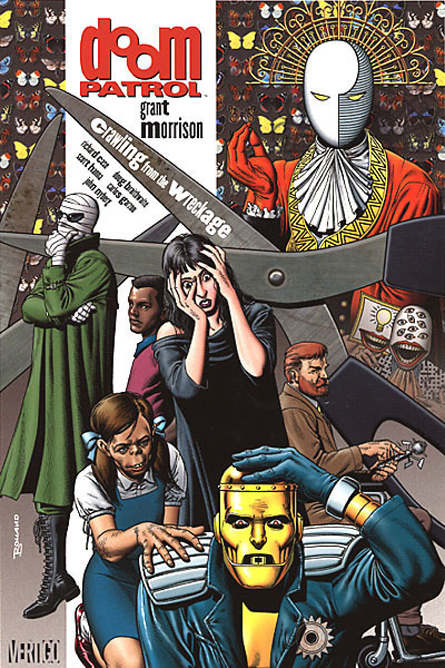
Grant Morrison’s run on Doom Patrol is probably the title’s most famous period, mostly because the author has gone on to become a massively influential force on the industry. His name on the cover is not the only reason the period is viewed fondly though. Morrison’s Doom Patrol is inventive and bizarre and has a wealth of odd characters populating its pages. Morrison successfully took existing team members and made them his own, something which has developed into a trend as his career has progressed. These are the definitive interpretations of the Doom Patrol regulars.

Unfortunately none of this means it’s a completely flawless read. Various aspects of the book fail to hold up two decades later. While Brian Bolland’s covers are wonderful displays capturing the anarchic plots of the issues they’re for the interior artwork from Richard Case is decidedly of its time. It feels scrappy and rough around the edges, failing to create a feeling that you’re reading something special. He does fare better when creating reasons to empathise with the characters, serving Robotman particularly well.

Another problem is the central villain, revealed in the sixth collected volume. The revelation that the professor has turned bad reads like a shock for the sake of a shock, another trope that has become associated with Grant (see in particular his various Infinite crossovers for DC). It does make sense by the end of the final issue if you’re willing to give the title the benefit of the doubt. The Candlemaker is a poor attempt at a major villain. He has an underwhelming, unmemorable look and motives that are impossible to decipher.

The title loses steam over time. It feels like Morrison becomes disinterested. It’s great until that happens though. Morrison tosses in some truly bizarre ideas. The Brotherhood of Dada is a highlight, a group of rogues who are more interested in causing trouble than world domination (or any other generally recognised trait of comic book villains). Members included a woman who had practically unstoppable powers but could only use them when she was asleep, the concept of distraction, a living whirlwind, and a woman who had every superpower you hadn’t thought of before facing her.

Another intriguing creation is Red Jack. A being that lives off pain and thinks he is both God and Jack the Ripper? The character could have overstayed his welcome but Morrison thankfully uses him judiciously and leaves us wanting more. It’s the kind of creation he is known for these days.

Issue 45 introduces us to the Beard Hunter, a man who hates facial hair so much that he is driven to kill anyone who sports it (a not-at-all-hidden play on the Punisher). Unsurprisingly he targets the only member of the Doom Patrol who has a beard. It’s a weird, silly idea that you couldn’t get away with in most comics. There’s a living street called Danny, an infinite city, scissor men who cut people out of reality, and a bit part golden age homage named Flex Mentallo who proved so popular he got his own miniseries. Morrison tosses out ideas like they’re going out of style.

As mentioned above Morrison serves the regulars well. Cliff remains the relatable everyman similar to the Fantastic Four’s Thing while Negative Woman is revamped into a deliberately unrelatble omnipotent hermaphrodite. The Chief (again, as mentioned) is revealed to have gone a bit wrong, which gives him some substance and a reason for existing beyond being a wafer thin Professor X analogy. It’s a twist for the sake of a twist but it at least makes use of the tools Morrison has at his disposal.

Crazy Jane and Danny the Street are the creative team’s own contributions to the group’s roster, and they also fleshed out a background character that first appeared before they took over into Dorothy Spinner. Danny is the aforementioned sentient street that acts as base of operations for the team. Jane is a young woman with multiple personality disorder, each persona possessing its own power. Dorothy is a young girl with a monkey face who is responsible for the Candlemaker’s existence. The Doom Patrol should’ve offed her when they first met her to save themselves (and us) some bother.

Despite its faults Morrison and Case’s Doom Patrol is a fun and inventive title that never fails to surprise. While its ideas and artwork aren’t the most consistent it’s worth reading for when things go right. Anyone interested in the career progression of Grant Morrison, and his regular themes of sexuality, political commentary, and society’s present and future, will not be disappointed.

Sunday, 28 October 2012

New X-Men


The X-Men are generally thought of as a large team. The modern comic book landscape has encouraged this view, with Marvel cashing in on their popular franchise by running half a dozen or more books bearing the X name at any one time (almost all of which feature Wolverine, in a surprisingly varied number of outfits). Some titles are naturally better than others, thanks to the diverse range of authors and artists working on the books and the characters they are permitted to use.

In 2001 Marvel brought lauded writer Grant Morrison on board to revamp their X books. While other titles were still produced during Morrison’s run it was clear that his New X-Men was the “main” one. The one where all the stuff that truly mattered would happen.

Morrison made sweeping changes to the group and the title. He pared the membership of the team right back, presenting us with a six person outfit consisting of Cyclops, Beast, Emma Frost, Jean Grey, Professor Xavier, and, of course, Wolverine. They were joined by debuting peripheral characters Beak, Angel Salvadore, and the Stepford Cuckoos. The first several stories Morrison told concentrated on the existing stars. The newcomers became more prominent over time, allowing readers to get to know them at a natural, unforced pace.

The X-Men were kitted out in new black and yellow outfits, which helped to make them look more like a team and less like a disparate bunch of camp cosplayers, and the book gained itself a snazzy new name and logo. The word New hadn’t been appropriate for an X-Men title for quite a while, and it arguably wasn’t relevant here. Marvel used the name anyway.

Morrison controversially altered the look of Beast, taking him from ape-like to cat-like. Many disliked the change but as Morrison pointed out Hank McCoy had started out as a regular(ish) looking guy with oversized hands and feet. The move to a cat was presented as a progression of the character’s X-gene and formed the basis for Morrison’s final story.

Emma Frost gained a secondary power. In addition to telepathy it was revealed she could turn her body into a diamond-like substance. Useful for a superhero, no?

The book also gave us the first appearances of Fantomex and the ultimately controversial Xorn character. Fantomex has always struck me as a far too powerful character and one created designed to be cool rather than layered or interesting. Most people disagree and cite him as one of Morrison’s greatest achievements while writing New X-Men.

Xorn is another kettle of fish entirely. With him Morrison did manage to create a layered and interesting character, one that fans and critics alike loved. He was vulnerable and different to the rest of the cast. The identity of Xorn is a major event during the run so I shan’t spoil it here, but suffice it to say that when you find out who has been under the mask all along you’ll find yourself checking previous issues. The plan, plot and character reasoning make no sense.

Morrison returned a sense of unpredictability to the X-Men that had been missing for a while. The team had spent much of the 90s being broody in dull, unimaginative stories or retreads of past glories. From early on it’s clear Morrison wants to do things with the team that haven’t been done before, putting them into new situations and surroundings while staying true to their history and maintaining the traits that made them originally appealing.

Chris Claremont was famed for including analogies of racism, gender inequality and various other types of persecution in his X-Men titles. Morrison very much tries to follow suit. For the most part he succeeds.

But in amongst all these changes, new characters, and expanded worlds are there good stories? At the beginning of the run, yes.  Morrison produces some fairly imaginative storylines. An early story sees Professor X seemingly turning evil, for example. That’s a simple idea but one that had never been done before (certainly not in this fashion at any rate).

There’s a problem with the title though. The artists are nowhere near consistent enough. When Frank Quitely is on pencil duty the book is a joy and a triumph. He understands how to put Morrison’s thoughts onto the page better than anybody else. Unfortunately he’s around less and less as Morrison’s creative run goes on, and almost all of the fill-in artists are dreadful. Busy panels, sloppy inking and inconsistent character designs make the book painful on the eye as early as halfway through the first volume (of three).

The series ends on a high with Morrison’s own attempt at a Days of Future Past type plot. It brings together elements, some major, some minor, spanning Morrison’s run. The basic gist is that Beast has gone bad and waged war on the rest of the X-Men, determined to retrieve and revive the Phoenix to rule the world (or something equally nefarious). At points it comes across as an over-the-top apocalypse movie form the 80s but it works well and allows the Morrison era of the book to end on a high. Perhaps Morrison should try an 80s apocalypse movie-style film script at some point?

If you can look past haphazard artwork there’s a lot to enjoy about New X-Men. Sadly that’s far easier said than done.
 
Critical information:
Writer: Grant Morrison
Artist: Various

Sunday, 12 August 2012

All-Star Superman


We all know the Superman origin story. He is the last survivor of a dying race of superbeings, sent to Earth and raised on a farm before growing up to become the morally righteous world protector with a penchant for red underwear and capes. The character has been rebooted, adapted and updated so many times over the last decade or three that a nauseating number of stories recounting this simple tale now exist.

Thankfully when Grant Morrison wrote the twelve issue All-Star Superman he boiled down the thirty years or so of Superman’s life to eight words split across four panels. That was the first of many things he got right with the series.

All-Star Superman celebrates the character’s sixty-plus years of canon and history without ever becoming beholden to it. If something works Morrison includes it. If something is best left forgotten then it is. Numerous aspects of Superman and his world are reworked all in order to give us the best story possible, often things you wouldn’t expect to appear in such a relatively short series. That’s exactly how comics should be written.

Jimmy Olsen is transformed from irritating sidekick to brilliant scientist. The Fortress of Solitude is accessed using a key that weighs half a billion tonnes. The high intellect of the character, so often forgotten or downplayed over the decades, is highlighted at various points and there are dozens of examples of Superman truly being the strongest man on Earth, again something his regular appearances often downplay in order to heighten drama.

The premise of the series is setup in the very first issue. After Superman thwarts the latest diabolical plan of Lex Luthor it is revealed that ‘The Man of Steel’ has become oversaturated with solar radiation and is given a limited amount of time to live.

This development not only makes Supes fallible but it gives him something he so rarely has in modern comics: a purpose. Knowing he is going to die Superman focuses on tying up loose ends and ensuring that the world will be safe in his absence. There are some beautifully touching moments between the character (both as Superman and Clark Kent) and his father and Lois Lane.  

It all naturally comes down to a final showdown with Luthor, but it is far from the by-the-numbers Kryptonite-filled encounter most fans would (rightfully) expect. The climactic confrontation is just one of many instances in which Morrison defies expectations and surprises everyone from long term fans to those just picking up their first comic.

Morrison’s script truly does Superman justice. Fun, exciting adventures are woven with believable characters. Frank Quitely’s artwork is the perfect fit for the title, with Superman being all lantern jaw, boyish cowlick and kindly smile. Morrison has provided an excellent script but it’s Quitely who expertly brings it to life and imbues it with a warmth and sense of wonder rarely associated with famous Metropolis resident.

Whether you’re a fan of the character or not you will enjoy this book.

Critical information:
Writer: Grant Morrison
Artist: Frank Quitely
ISBN: 9780857688170